
Browse High Point Directory Sources
High Point people directories do not form one master list. Each directory answers a narrower question. City and school rosters identify people in public roles. High Point University lists faculty and staff. County tax data names current parcel owners, while deed books preserve earlier grantors and grantees. The Heritage Research Center reaches past residents through printed directories, obituary files, newspapers, and school publications.
| Directory Source | People Named | Record Keeper | How to Use It |
|---|---|---|---|
| City staff search | Officials and city employees | City of High Point | Free name or category search |
| HPU directory | Faculty and staff | High Point University | Free name, role, school, or department search |
| School rosters | Teachers and school staff | Guilford County Schools | Individual school pages |
| Property and deed indexes | Owners, grantors, and grantees | Applicable county | Web search plus office records |
| Professional and entity lookups | Licensees, agents, and officers | State boards and Secretary of State | Board or entity search |
| Historic city directories | Residents, firms, and groups | Heritage Research Center | Printed run, staff help, and digital subsets |
Choose by the relationship being checked. A department is the fastest route to a city worker. A street address points toward the property roll and historic volumes. A past school, factory, or club can lead to a yearbook or newsletter. Current residential white pages, congregation rosters, neighborhood lists, and a High Point-only countywide school search were not found in authoritative sources, so those gaps should not be filled with unverified listings.
Who High Point Government Directories List
The city directory can be searched by department category, first name, or last name. Categories include City Council, the Clerk, Police, Library, and other departments and divisions. Result rows can show a name, title, email, work phone, and additional phone. Department views may add the office address, mailing address, and hours. That makes the roster useful when only a surname, public role, or unit is known.
| Category | Optional department, division, council, or office filter |
|---|---|
| First Name | Optional text search |
| Last Name | Optional text search |
| Sample Result | Mary Sizemore, Executive Team, Library Director, 336-883-3631, fax 336-883-3636 |
| Other Result Fields | Title, email, phone, and additional phone |
The High Point staff directory search shows the form used to narrow a roster by name or category.
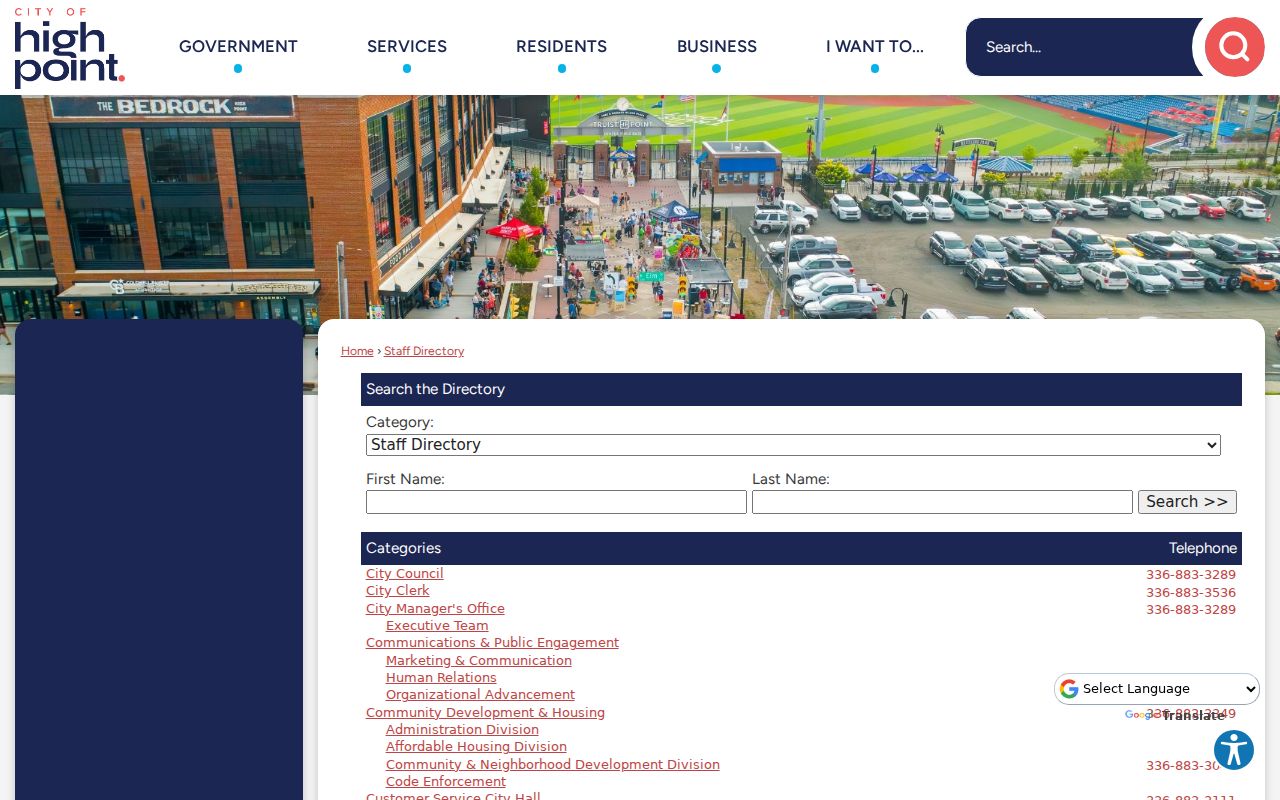
The visible filters make department browsing a practical fallback when spelling is uncertain. If no entry appears, call the department’s main line or ask the City Clerk which office holds the current contact record. A Chapter 132 request may be made without giving a name, reason, or North Carolina residency, but detailed access rules belong with the High Point public records process.
High Point Education Directories
Education directories split at the institution level. High Point University permits a search by a person’s name or role, with added filters for school, college, and department. Results can display the person’s name, title or role, institutional email, and telephone. The fields are broad enough to find a person when a role such as admissions, biology, or student services is known but the surname is not.
| HPU Search Field | Input | Required | Use |
|---|---|---|---|
| Search by Name or Role | Text | No | Person name or work role |
| Schools & Colleges | Dropdown | No | Academic unit |
| Departments | Dropdown | No | Department filter |
| Sort | Dropdown | No | Result order |
The High Point University directory presents those name, role, and academic-unit controls in one search.
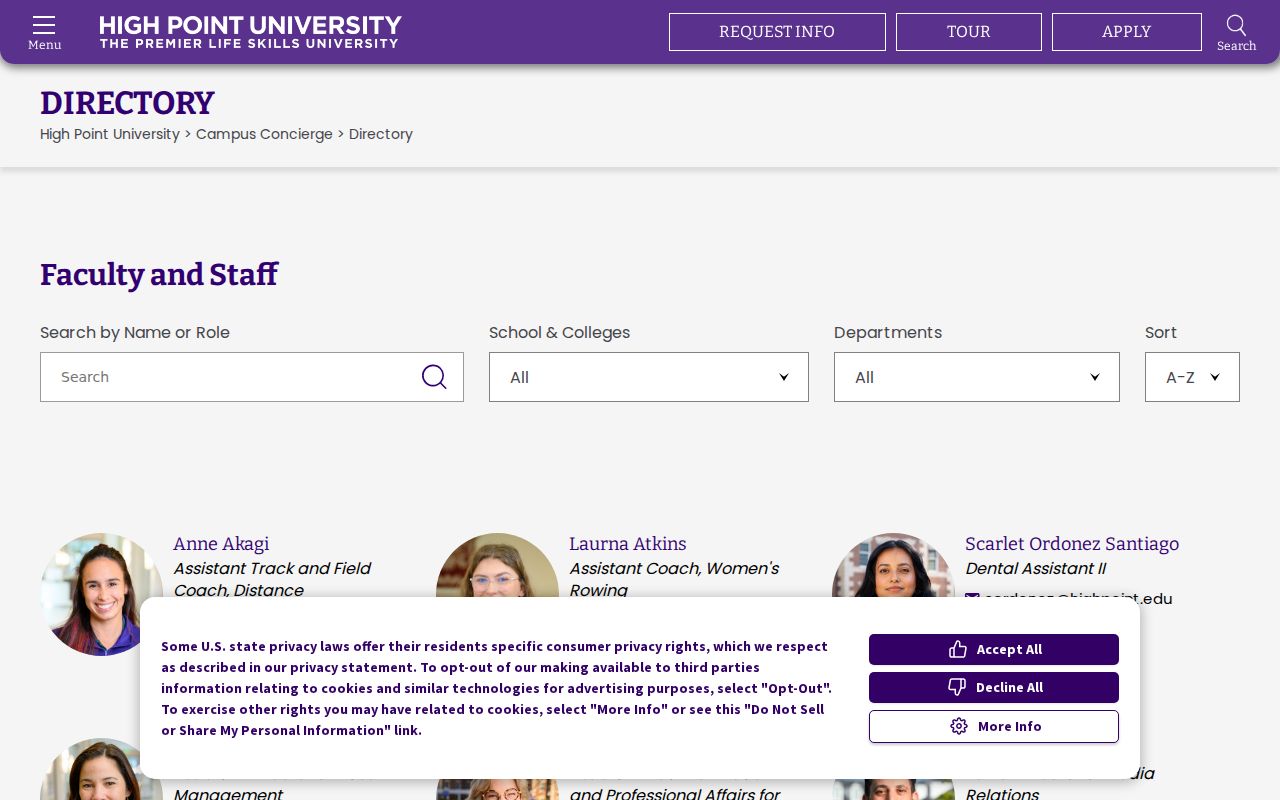
The screen confirms that role and department are useful paths alongside a name. Guilford County Schools uses school-by-school rosters instead of a clean High Point-only district search. The High Point Central staff roster, for example, lists a person’s name, title, and email.
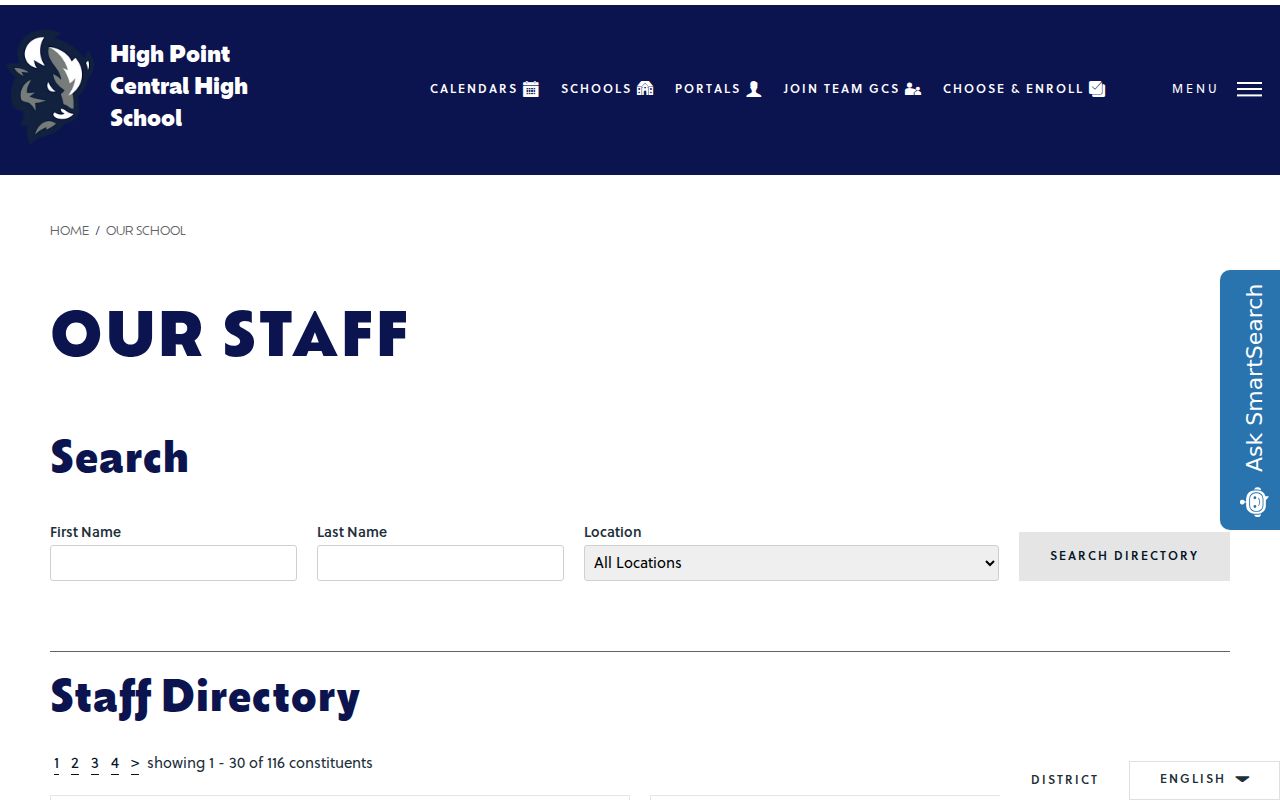
The school page shows why the campus must be identified before searching. When a roster lacks the person sought, use the school’s main contact rather than assuming the person is absent from the district.
High Point Property Owner Directories
Tax rolls and deed indexes work as people directories when the known fact is a house, lot, or owner name. Begin with thePOINT to confirm whether the address is in Guilford, Davidson, Forsyth, or Randolph County. A High Point postal address alone cannot settle that question. The matching county tax search can then return an owner, owner mailing address, situs address, parcel number, legal description, value, and sale reference.
The Guilford Real Property Search accepts owner, location address, parcel, and related search modes. “Situs” means the physical property address, while the mailing address is where the tax owner receives mail. Neither proves that the owner lives at the parcel. For earlier owners, follow a deed book and page into the Guilford land-record index, then search grantors and grantees, the parties who transferred or received an interest.
County check: High Point spans four counties. Use the county tied to the exact parcel before treating a blank directory result as a nonmatch.
Web indexes are not the only channel. Guilford’s official land record remains at the Register of Deeds office, and office indexes or copies can fill gaps. For parcels beyond Guilford, repeat the owner and deed search with the correct county tax office and Register of Deeds.
High Point Professional Directories
Professional records are divided among North Carolina boards. The state hub routes searchers to the agency that licenses a field, while NC BOLD identifies license requirements and issuing contacts. A board verification may show a name, credential, standing, dates, and discipline where the board publishes those fields. There is no single generic state business license, so the profession must be identified first.
The North Carolina license directory is the official starting point for board-specific checks.

The board list helps distinguish a licensing source from a general name directory. Business entities use the Secretary of State registration search, which can expose a legal name, status, formation details, registered agent or office, addresses, filing images, and officers when supplied. Assumed names may instead be filed with the Register in the county where the business operates.
High Point ended its general city business registration in 2026, so an archived city application is not a current directory. The separate furniture-showroom tax remains, but it tracks qualifying showroom operations rather than every local firm.
High Point Historical Directory Timeline
Historic High Point people directories preserve residents whom current lists cannot reach. The city’s first directory appeared in 1908, and the Heritage Research Center holds printed High Point-area editions from 1910 to the present. Entries may identify a person, home address, occupation, business link, organization, race, and later a telephone. No official source confirms which exact editions are reverse or criss-cross volumes, so ask staff which books support an address-to-occupant search.
| 1859 | High Point incorporated; surviving council minutes begin, with a later nineteenth-century gap |
|---|---|
| 1886 | High Point Enterprise microfilm begins, though coverage before 1915 is incomplete |
| 1908 | First known High Point city directory |
| 1910 to present | Printed directory run held by the Heritage Research Center |
| 1923 to 1924 | A High Point city directory is available as a scanned volume |
| 1973 to 1976 | The African-American Tribunal Aid is complete online |
The Heritage Research Center at 901 N. Main Street offers in-person and staff-assisted access, plus library computers that unlock restricted FamilySearch images through its affiliate status. Call 336-883-3637 before a visit. When staffing is thin, the room may close for an hour near midday.
High Point Obituary Directory Trails
The Heritage Research Center maintains a staff-created High Point Enterprise death and obituary index. Newspaper film starts in 1886 but has gaps before 1915, so a missing item is not proof that no notice ran. Staff can also check the Greensboro Patriot and other High Point newspaper film. Obituaries often connect a deceased person to relatives, churches, firms, and burial places.
City cemetery records add a different directory. High Point operates Oakwood Municipal and Memorial, Greenhill, and Kersey Valley cemeteries. Oakwood has more than 5,000 burials, Greenhill about 1,250, and Kersey Valley includes unmarked or unknown graves. The city cemetery service supports burial searches and office help; the Cemetery Division can also be reached at 512 Steele Street or 336-883-3408.
Pair the obituary index with a cemetery response rather than relying on one source. A death notice may name family and a funeral, while a burial record can confirm the cemetery and plot.
High Point Directory Gaps Matter
An online directory is only one snapshot. City and campus rosters change with current roles. Property rolls identify owners rather than occupants. A historic volume may skip a year, household member, or newly annexed street. Search fields can also fail on initials, alternate spellings, married names, or OCR errors. Those limits make a second directory more useful than repeated searches of the first.
- Index
- A name-and-reference list that points to a fuller record or image.
- Reverse directory
- A directory arranged by street address, useful for tracing occupants when available.
- Grantor and grantee
- The parties conveying and receiving an interest in a recorded land instrument.
- Situs address
- The physical parcel address, which can differ from an owner’s mailing address.
A sound match joins two independent details, such as a directory address and a yearbook, or an obituary relative and a cemetery entry. Use lawful personal research only. Public access does not permit stalking, threats, impersonation, or harassment.
High Point Digital Directory Additions
A March 2025 digitization batch expanded the High Point record trail with factory newsletters, school and religious publications, club materials, and a landowner and business guide. The additions include Adams-Millis Amco News, Melrose Hosiery Mills Mel-Rose-Glen, St. Mary’s Episcopal and B’Nai Israel items, and a 1941 to 1942 Alpha Art Club directory.
The digitized 1923 to 1924 city directory shows how an online scan can establish a person at a dated address before a trip to the library. Search within the scan, then browse nearby entries and business pages. Names found there can be checked against yearbooks, newspapers, deeds, or the staff-assisted obituary index.
These new digital directories reflect High Point’s furniture, textile, school, faith, and civic networks. They are especially valuable for people whose names survive in group records rather than in government staff lists.