
Search High Point Voter Registration
The NCSBE Voter Search is the official place to check an individual High Point or North Carolina voter record. Enter the person's first and last names, then use the optional middle initial, year of birth, and county to narrow common names. The status controls allow a search of registered records, removed or denied records, or both. Start broad when spelling or county is uncertain, then add filters after reviewing the first results.
The form does not require a full birth date, Social Security number, or driver-license number. Those are not public search keys. This focused design makes it possible to confirm a High Point record without collecting highly sensitive identifiers. A result should still be checked against county, precinct, and status because several people can share a name.
| Search control | Input type | Needed? | How to use it |
|---|---|---|---|
| First Name | Text | Yes | Main given-name key |
| Middle Initial | Text | No | One initial can narrow matches |
| Last Name | Text | Yes | Main surname key |
| Year of Birth | Dropdown | No | Helps separate people with the same name |
| County | Dropdown | No | Choose the county of residence |
| Voter Status | Checkboxes | Yes | Select Registered, Removed or Denied, or both |
| Search / Reset | Buttons | Action | Run the lookup or clear all fields |
The state form is easy to recognize in the official voter lookup screenshot:
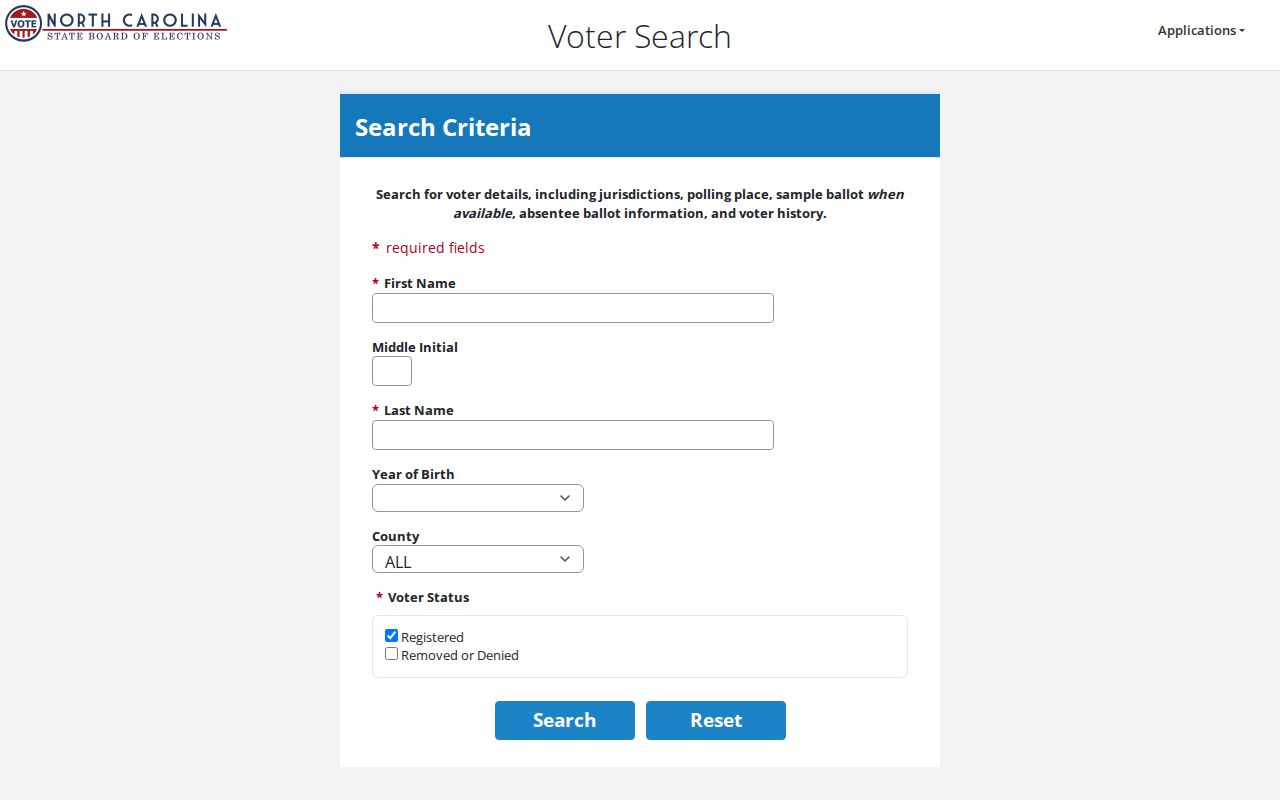
Its High Point name-first search is meant for checking a particular High Point record, while bulk review belongs in the state's downloadable files or a county list request.
Choose High Point's Correct County
High Point is principally in Guilford County, yet parts of the city lie in Davidson, Forsyth, and Randolph counties. Municipal limits do not decide which county board keeps a resident's record. Use the exact residential address to establish the county before filtering the state lookup or contacting local election staff. A Guilford search can miss a valid High Point resident who lives across one of those county lines.
For a Guilford County record, the Guilford County Board of Elections has a High Point office at 325 E. Russell Avenue. Staff can be reached at 336-641-3836, by fax at 336-641-7676, or at guilfordelections@guilfordcountync.gov on weekdays from 8 a.m. to 5 p.m. Residents in the other three counties should use that county's election board instead.
The county elections office pictured here is the local custodian for Guilford voters:
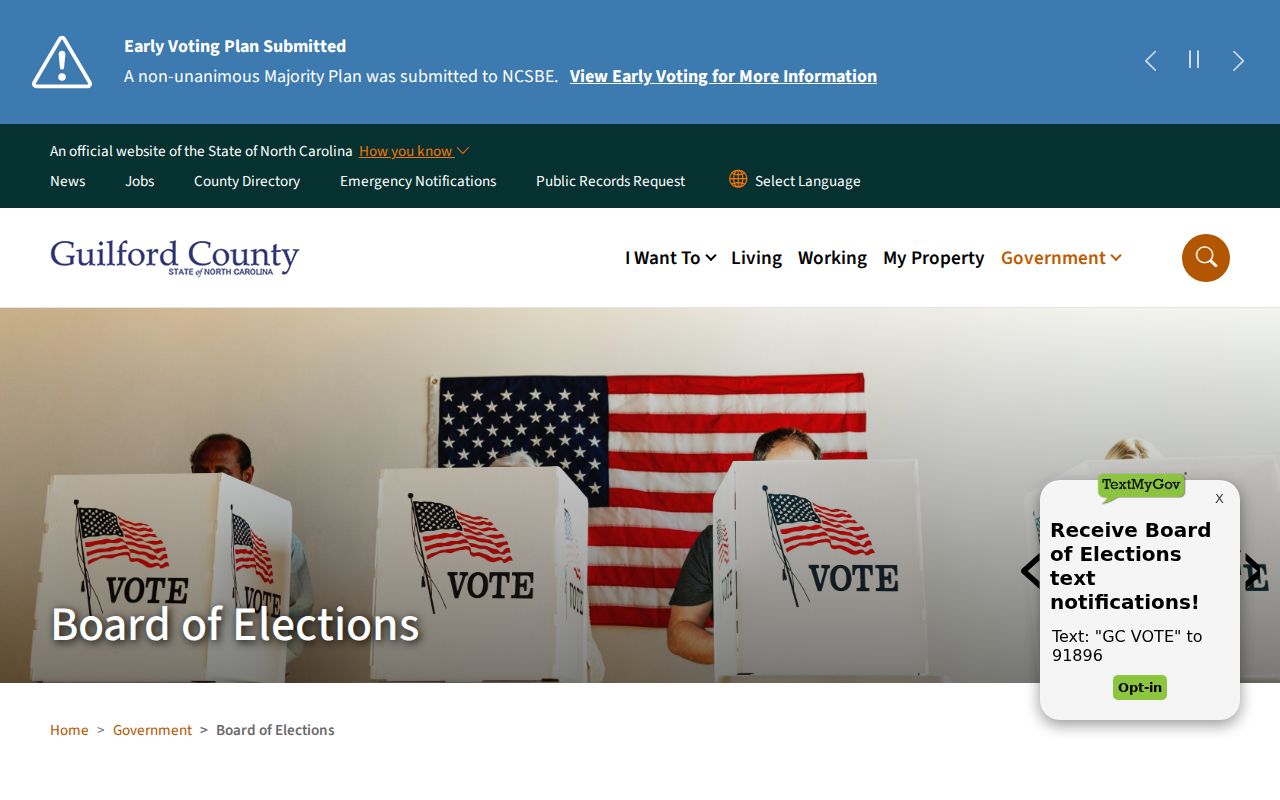
That distinction matters for county and precinct lists, address questions, and corrections that a statewide result cannot resolve.
What High Point Voter Records Reveal
A public match can identify the voter's name, county, current status, registration date, party affiliation or unaffiliated status, precinct, polling place, and assigned voting districts. It may also include election participation history. These fields help distinguish two people with similar names and show whether the record belongs to the expected part of High Point.
Read each High Point field in context. The polling place reflects the assigned site for the record, while the district lines identify the contests tied to that address. A status field describes the state of the registration record, not whether someone appeared in every election. Party affiliation is public in North Carolina, but it does not disclose which candidates the person supported.
| Name and county | Public identity and jurisdiction fields |
|---|---|
| Residence or mailing address | Generally public, except a protected address |
| Party choice | Affiliated party or unaffiliated status |
| Precinct and districts | Local precinct plus assigned voting districts |
| Registration details | Registration date and current status |
| Participation history | Election and voting method when supplied, never ballot choices |
| Sensitive identifiers | Birth date, SSN, license number, email, and ID material are withheld |
North Carolina keeps key fields confidential. Under N.C.G.S. §§163-82.10 and 163-82.10B, birth dates, Social Security and driver-license numbers, email, the registration agency, and copies or photos of identification are not public. A signature may be viewed, but it may not be copied or traced.
Protect High Point Voter Addresses
Most High Point residence and mailing addresses in the voter roll are public. North Carolina creates a narrow safety exception. A voter with a qualifying protective order, or a current Address Confidentiality Program card plus the required safety statement, may have the residence address suppressed under §163-82.10(e). The voter's name, precinct, and other public fields remain available.
The North Carolina Address Confidentiality Program provides a substitute address and mail forwarding for qualifying High Point survivors who relocate. It covers survivors of domestic violence, sexual assault, stalking, and human trafficking. It is a formal protection, not a general removal option for anyone who would prefer that an official record disappear.
This split explains why two otherwise similar High Point results may show different address detail. Never try to reconstruct a suppressed residence from another source or use public precinct data to defeat the safety measure.
Note: Address suppression protects the residence field, not every public fact tied to a North Carolina voter record.
Read High Point Voter History Correctly
High Point election history is a participation record. It can identify an election in which a person took part and may include the voting method, such as the method supplied in the state history file. It never reveals a candidate choice, contest selection, or ballot position. Ballots and the way an individual voted remain confidential.
This is an important limit because a High Point history row is easy to overread. Party affiliation is also not a ballot record. A person may register with a party or as unaffiliated, yet the public file still cannot show how that person marked a ballot. North Carolina treats disclosure of an individual's vote as an election-law offense.
Participation is not a vote choice. A date and election name prove only that the record reflects participation. They do not support claims about which candidate or issue the voter favored.
Retry a High Point Voter Search
A High Point nonmatch is not proof that a person never registered. Try a former surname, a spelling variation, or a different middle initial. Remove the optional year of birth if it may be wrong. Search both Registered and Removed or Denied statuses. Then test the person's former county, especially after a move within High Point's four-county footprint.
Recent High Point address or status changes can also explain a mismatch between expected details and the current result. County election staff are the fallback when the state form does not settle the issue. Give the staff member enough accurate information to identify the record, but do not send sensitive identifiers by ordinary email unless the office specifically requires a secure method.
Note: A careful second search should change one field at a time so it remains clear which variation produced the match.
Track High Point Voter Roll Status
Registered, inactive, cancelled, removed, and denied are not interchangeable labels in a High Point search. North Carolina list maintenance under §163-82.14 uses weekly death and felony data, move information, and forwardable confirmation cards. A felony notice follows a separate 30-day process. These checks can change the status shown by the public tool over time.
Failure to return a confirmation card does not cause immediate cancellation. Cancellation for nonresponse also requires failure to vote through the second following federal general election. If the High Point voter continuously remained in the county, reinstatement is possible. That longer process is why an old or inactive record needs context before anyone draws a conclusion about eligibility or residence.
For long-range research, the State Archives county-record guide is an offline starting point. A digitized volume titled Permanent Registration of Voters, 1902–1908 records names, ages, qualifying ancestors, ancestral home states, and dates. It documents the discriminatory grandfather-clause system, so its fields must be read in that historical setting. Later Guilford poll-book years could not be confirmed from available official sources, making the Archives and local library the sound fallback rather than an assumed online run.
Request High Point Voter Lists
North Carolina law gives a different route for a High Point county or precinct list. Under §163-82.10(c), a county board may supply a list to any person and select records by party, gender, race, registration date, precinct or code, legislative or local district, and voter history. A list may be produced by age, but it cannot contain a date of birth.
Start with the board for the resident's actual county. Explain the geographic scope and fields needed, then ask whether a standard county file or a selected list meets the request. For Guilford voters, phone, email, fax, and an in-person visit to the High Point office are documented channels. The general North Carolina public-records process is covered separately under High Point public records access.
Custom statewide or selective High Point copies are also available under §163-82.13 at the actual cost of preparation. No current fixed-fee custom form was found in the available official sources. Ask for a cost estimate before ordering, or use the free standard ZIP file when it contains the needed fields.
Note: Ask for an estimate before custom work because no current fixed fee was found for a selected list.
Download North Carolina Voter Files
The NCSBE voter data page publishes free statewide and county registration downloads for High Point research. The files update on Sunday evenings. They include current status and reason, demographic fields, party, residence and mailing addresses, county, precinct, and districts. They exclude voter history, birth date, Social Security number, and driver-license number.
The state data page and its download choices appear in the official voter-file screenshot:
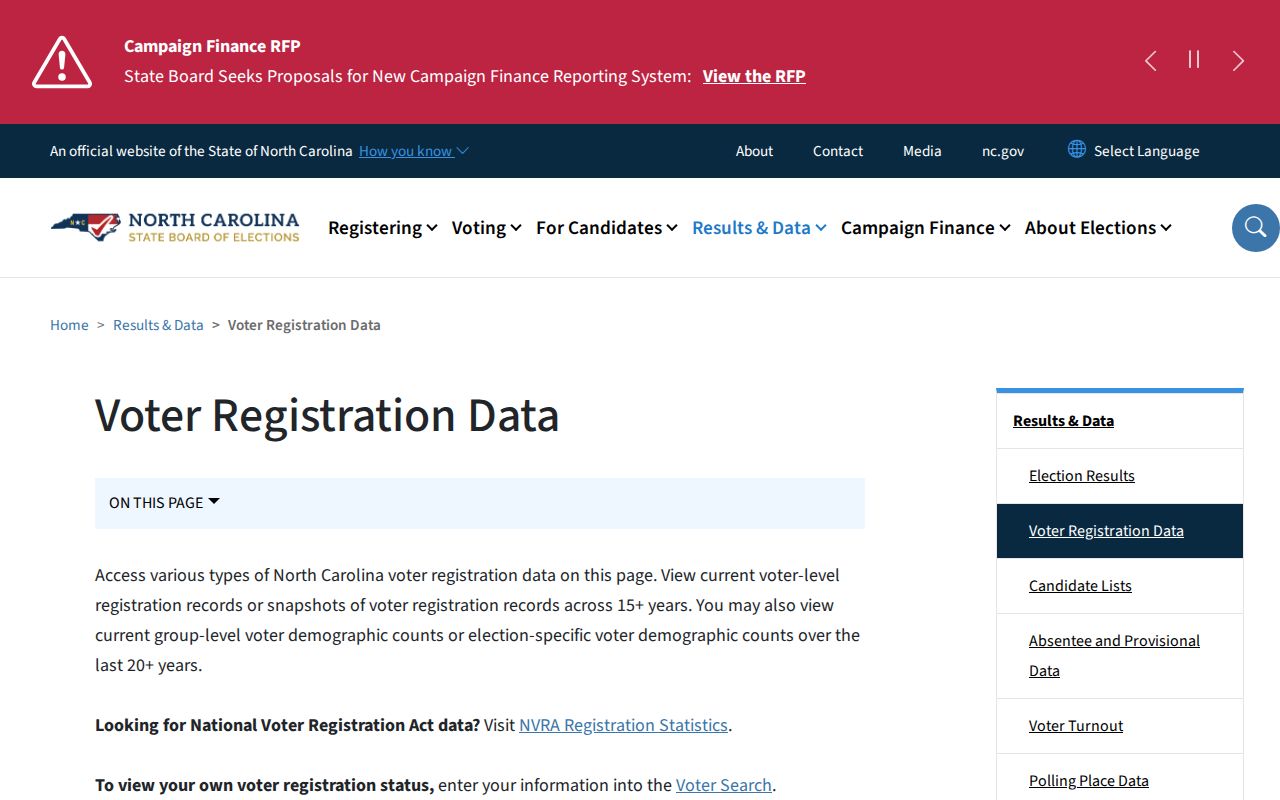
County files are often the easiest way to isolate High Point names after the correct jurisdiction has been established.
- Resolve the person's county from the current address before choosing a county download.
- Download the free current registration ZIP file and review its included fields and update date.
- For participation data, obtain the separate weekly history download covering the past ten years.
- Join registration and history rows by NCID or by the combination of county and registration number.
- Contact the county board or NCSBE for a custom selection only when the standard files do not suffice.
High Point history files contain registration number, NCID, party, county, precinct, election, and method, but no ballot choice. Removed voters whose last-voted date is more than ten years old are omitted from the current registration downloads. Historical snapshots span more than 15 years, offering a separate route when present status is not the research question.
Use High Point Voter Data Lawfully
High Point voter access is not permission to stalk, threaten, impersonate, steal an identity, or harass someone. North Carolina separately prohibits stalking under §14-277.3A, communicating threats under §14-277.1, and cyberstalking under §14-196.3. Trying to copy a view-only signature, defeat address protection, or disclose how a person voted also crosses clear election-record boundaries.
Use official data for lawful civic review, genealogy, or to confirm one's own record. Keep the source date with any downloaded file because the rolls change. Verify a key fact with the county board before relying on it, and report an immediate threat or fraud to High Point Police or the sheriff with jurisdiction.
General High Point questions about why a field is withheld should go to the elections custodian. The confidential/public split comes from election law, not from a portal error, and a broad records request does not override those protections.